
One session is enough because it works at the right level.
WHY INSIGHT ALINGE DOES NOT SHIFT BEHAVIOUR
Every leader can describe their own patterns: they know they shut down under pressure, they know they over-control, and they know they avoid the conversation that matters. They've seen it in their 360, their coach has named it and they've often named it themselves.
And the next time pressure arrives, the pattern fires anyway.
This is not a knowledge problem, a motivation problem, or a coaching problem. It’s a structure problem.
Automatic behaviour isn't held in the part of the brain that responds to insight, reflection or feedback. It's held deeper — in structures formed by earlier experience, reinforced by repetition, encoded below the threshold of conscious choice. Under pressure, those structures activate before thought. The leader doesn't choose the pattern. The pattern runs them.
Talking about a pattern at the level of awareness leaves the structure that generates it completely untouched. Which is why the same behaviour keeps returning — regardless of how much the leader understands it, or how committed they are to changing it.
SSC works at the level of the structure. Not the description of it.
WHY ONE SESSION IS ENOUGH
The conventional assumption is that behaviour change takes time. That is true for skill development and cultural transformation. It is not true for automatic pattern interruption.
Automatic patterns are condition-dependent — not time-dependent. The conditions that encoded the pattern are known. When those conditions are made visible and the pattern is interrupted at source, the behaviour loses its reason to persist.
This draws on the neuroscience of memory reconsolidation — the mechanism, demonstrated in clinical research, by which an encoded structure can be updated at source rather than managed at the surface.
Four decades of single session therapy research, developed by Moshe Talmon and extended across multiple clinical populations, consistently shows that a single well-executed session produces lasting change for the majority of people who experience it. The determining factor is not duration. It is whether the intervention reaches the correct level.
SSC reaches the correct level.
SURFACE. DECODE. RESOLVE.
Three movements. One session. Ninety minutes.
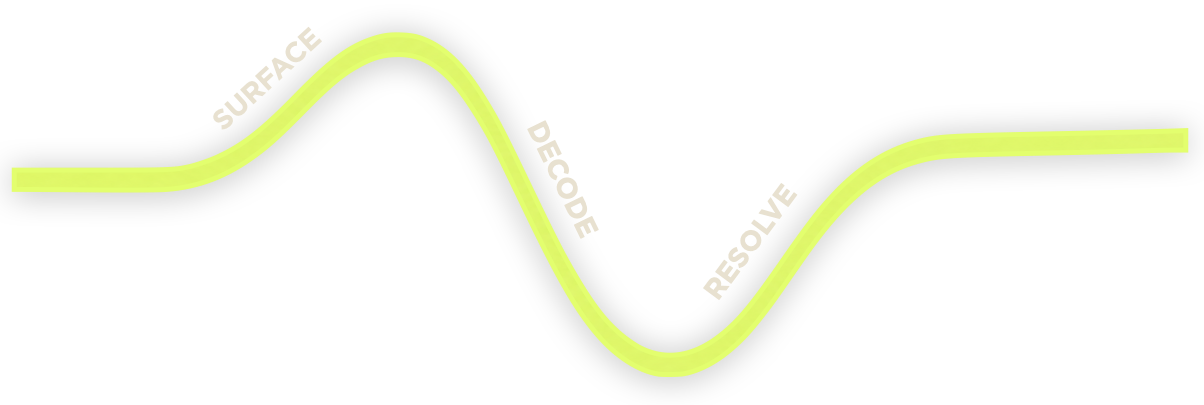
Surface. We identify the specific behaviour pattern — not the symptom the leader presents, but the pattern operating underneath it. Its context. The system it runs within. The conditions that trigger it.
Decode. We reveal the encoded origin. The belief, the inherited role, the unspoken loyalty that has been generating the behaviour. This is the moment the pattern becomes visible to the leader as something they have been carrying — not something they are. That distinction is everything.
Resolve. We interrupt the pattern at source. We work with the underlying structure so the behaviour no longer has a reason to persist. The shift belongs to the leader — not to the session, not to the coach.
What follows is consolidation, not continuation. Most leaders notice the shift within days — in how they respond under pressure, in what no longer triggers the old pattern. Full embedding typically takes two to four weeks. No further sessions required.
THE RESEARCH FOUNDATION
SSC is built on decades of peer-reviewed research into how behaviour is formed — and how it actually changes.
Antonio Damasio — emotion and embodied cognition. Behaviour is not generated by rational choice. It is generated by somatic markers — felt signals formed by prior experience — that activate before conscious thought. Change requires working at the level where those markers are held.
Bruce Ecker — memory reconsolidation. Encoded patterns can be updated at source when the right conditions are met. This is the neurological basis for lasting change in a single session.
Stephen Porges — the nervous system and safety. Genuine change requires a specific physiological state. SSC creates the conditions where that state is possible — and where the pattern can be seen clearly without triggering the defence that normally protects it.
Moshe Talmon — single session therapy. Forty years of clinical research demonstrating that one well-executed session produces lasting change for the majority of clients. Duration is not the determining factor. Level of intervention is.
Amy Edmondson — psychological safety. Hospital teams that appeared to make more medication errors turned out to be the only ones willing to report them. Google's Project Aristotle, across 180 teams, later found the same condition to be the strongest single predictor of team effectiveness, and a meta-analysis across 136 samples ties it to engagement, learning and creativity. Most of this evidence is correlational, and we say so. What lifts it beyond coincidence is the mechanism: under threat the prefrontal cortex disconnects, and the thinking you are paying for goes offline. Read the full argument. Read the full argument here.
Full citations for every source on this page are in the white paper and the calculator methodology.
WHAT CHANGES & WHAT DOESN’T
SSC is precise about what it is and what it isn't. It is not therapy. It does not work with clinical psychological conditions. It is not a substitute for coaching. Coaching embeds new behaviour over time — SSC removes what coaching would otherwise spend months working around.
It is not suited to skill acquisition from scratch, or to leaders without sufficient self-awareness to engage meaningfully with the work.
The scoping call exists to determine suitability honestly. If SSC is not the right tool, we will say so before any commitment is made.