
The Ants Don't Get Wiser, But The Colony Does
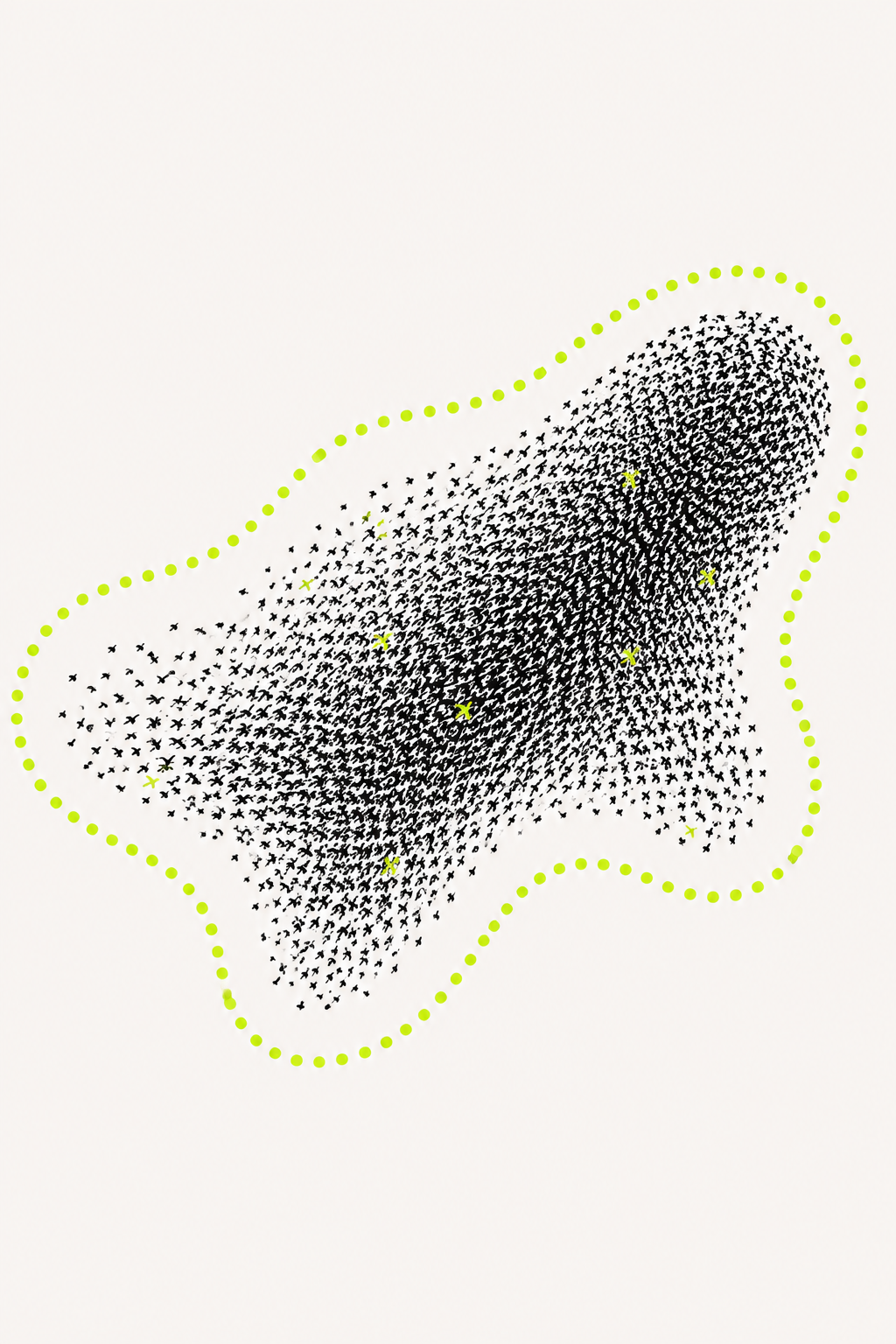
Organisations obey the same laws as living things: a metabolism, a set point, an immune system, and a memory that outlasts everyone in them. This is about why and how.
For nearly forty years, the Stanford biologist Deborah Gordon has spent her summers in a patch of New Mexico desert, politely vandalising the homes of red harvester ants. She blocks nest entrances, scatters obstacles across foraging trails, piles debris where the ants will have to clear it, and watches what a colony does when its world stops behaving.
A colony lives twenty to thirty years, the lifespan of its founding queen, while a worker ant lives about one. By the time a colony matures, no ant inside it was alive when it was founded and none has any experience of the colony being young. It ages anyway. Older colonies hold steadier under pressure: as Gordon escalated her disturbances, the young colonies grew more reactive while the old ones carried on foraging and absorbed the interference. Maturity shows up in the colony without a single individual inside it acquiring any, because whatever the colony has learned is held in the pattern of interaction between ants rather than in the ants.
Swap out a company's entire leadership team and it will usually carry on behaving exactly as it did before. Same trick, larger animal.
You have watched this happen. A reorganisation is announced with real conviction: new structures, new reporting lines, a new operating model, expensive help. Eighteen months later the same decisions are stuck in the same place, the same three people are the real bottleneck, and the same conversation still is not being had. Nobody sabotaged anything. Each person did something locally sensible, a manager holding a decision closer to protect quality, a director softening a message to protect a relationship, a team escalating upward to avoid a confrontation, and between them they put the organisation back where it started.
COMPANIES SCALE THE WAY ORGANISMS DO
We use biological language about organisations constantly. Healthy and toxic, DNA, bloated, atrophied, organ rejection after an acquisition. We assume we are speaking poetically when maybe we are being more literal than we realise.
Start with metabolism. In 1932 the Swiss-born biologist Max Kleiber, then working in California, showed that an animal's metabolic rate scales with body mass raised to the power of roughly three quarters, which means larger creatures run on systematically less energy per unit of mass. The relationship holds from mice to blue whales, and Geoffrey West and his colleagues at the Santa Fe Institute later traced the cause to the branching networks, circulatory and respiratory, that distribute resources through a body. The geometry of the network sets the maths.
West pointed the same lens at companies. Their key metrics scale sublinearly too, in the manner of organisms rather than of cities, which run the other way and keep growing indefinitely. In biology, sublinear scaling is what produces bounded growth and a finite lifespan. Growth slows, size plateaus, the organism dies.
The mortality data agrees. In 2015 a Santa Fe team ran survival analysis on more than 25,000 publicly traded North American companies across six decades and found a constant hazard rate. A firm's risk of disappearing in any given year has almost nothing to do with how long it has already survived or what it sells: bananas or aircraft, forty years old or four, the rate holds, and the half-life of a public company is about a decade. That is the shape of a survival curve, which is the shape you get from a population of living things.
Regularities of that kind describe populations of firms rather than mechanisms running inside any particular one, so the maths sets the odds your company is playing against rather than its fate. What makes the resemblance worth taking seriously is that it keeps holding further down, at the level where you actually work.
EVERY ORGANISATION DEFENDS A SET POINT
Walter Cannon named the thing that holds a body steady while its surroundings change. He coined homeostasis in the 1920s and set it out in full in The Wisdom of the Body in 1932. Your core temperature sits near 37 degrees because thousands of local mechanisms make small corrections in response to purely local signals: sweat glands open, capillaries constrict, you reach for a jumper without registering the decision. Nothing in the system knows the number, and the number holds anyway.
Gordon's colonies do this with no manager anywhere in them. The proportion of ants out foraging, patrolling or clearing the nest tracks conditions outside through nothing more sophisticated than the rate at which ants meet each other and pick up a scent. No ant holds the target, and the target is held.
Your reorganisation met the same machinery. Every individual adjustment was reasonable, and between them they restored the set point, which is what Donella Meadows called policy resistance and treated as the signature of any system whose actors are pulling towards different goals. A company that snaps back is doing its job.
THE IMMUNE SYSTEM, AND WHY IT ATTACKS THE CURE
In the 1970s and 1980s the Harvard theorist Chris Argyris documented what he called organisational defensive routines: the actions, policies and unspoken rules that protect people from embarrassment or threat while stopping the organisation from learning anything. Their defining property is that they are self-sealing. The routine is undiscussable, and its undiscussability is undiscussable too, so surveys and values workshops slide straight off them.
Read that as immunity and it stops reading as dysfunction. An immune system attacks whatever it identifies as foreign, using rules acquired from earlier exposure, and it cannot tell a pathogen from a transplant that would save the patient's life. This is how a good idea, raised by a credible person, at the right moment, gets rejected by the organisation that needed it most.
At Single Session Coaching we work with seven of these reflexes and give them plain names: Smoothing, Deferring Up, Going Quiet, Shutting It Down, Defending, Taking Over, Firefighting. Each began as an intelligent response to a real threat. Smoothing protects a relationship, Deferring Up protects a career, Taking Over protects quality at a moment when quality was genuinely at risk, Firefighting protects a customer. Calling them character flaws is among the most reliable ways to make them stronger, because a defence under criticism learns to operate more quietly.
Gordon's young colonies show the failure mode. The worse she made conditions, the harder they reacted, until reacting was most of what they did, while the older colonies took the same interference and carried on feeding themselves. An organisation in permanent firefight is a young colony with a large payroll.
The reflexes carry a metabolic cost. Crucial Learning, the firm behind Crucial Conversations, found that employees lose more than $1,500 and a full working day for every crucial conversation they avoid rather than hold. That is one reflex, firing once, in one person. In a leadership population they fire continuously, in the rooms where the expensive decisions get made or postponed.
MEMORY WITHOUT CELLS
Living systems remember things that none of their current parts ever experienced. Gordon's colonies do it, and so do we, and there is a beautiful old experiment that shows the mechanism.
In 1961 Robert Jacobs and Donald Campbell used the autokinetic effect, the illusion in which a stationary pinprick of light in a dark room appears to drift. Left alone, people estimate the movement at around four inches. Jacobs and Campbell seeded their groups with confederates instructed to report a wildly inflated fifteen or sixteen. Then they pulled the confederates out one at a time, replacing each with a naive participant, until everyone in the room had arrived after the last confederate had left.
The inflated number outlived them. The arbitrary norm passed through several generations of complete turnover, decaying slowly towards reality and persisting well beyond anyone who had a reason to hold it. The later participants believed their own estimates, sincerely, inside a room whose measurement of reality had been calibrated by people they never met.
That is culture at the level of mechanism. It has little to do with values on a wall or with what the founder intended, and everything to do with a pattern of interaction that sets what people believe they are seeing. Plenty of the norms running your organisation were installed during a genuine emergency by a leader who left in 2014.
WHAT THIS MEANS IF YOUR JOB IS TO CHANGE ONE
The machine model makes a training programme a logical intervention: upgrade the components, improve the output. Most of what gets bought in learning and development runs on that assumption, and much of it disappoints the people who signed the purchase order.
Run the organism model and the same programme looks different. It arrives as a foreign body, into a system defending a set point, with an immune response that is undiscussable by design and a memory older than everyone in the room. The host decides the outcome, and the host is doing what hosts do.
Living systems respond poorly to volume and well to leverage. Meadows spent a career arguing that the highest-leverage places to intervene are the least intuitive, and that they sit a long way from the parameters and structures we reach for first. In an organisation the leverage sits with the handful of people everyone else watches, because behaviour transmits by demonstration long before it transmits by instruction. When one senior leader stops smoothing and says the true thing in the room where it counts, the copying chain beneath them updates, and no workshop is required.
RELEASE RUNS FASTER THAN BUILD
Set the two routes side by side. The first is a capability build: a leadership curriculum, a coaching cohort, a competency framework, delivered over months to as many people as the budget allows. It works by adding something that was never there, and it is slow for an honest reason, because new capability has to be installed, practised, and defended against everything already in the building.
The second route starts somewhere else. The capacity to say the difficult thing is already present in almost every senior leader, and has been since long before they were senior. What sits on top of it is a guard, installed at a particular moment, for a reason that made sense at the time and has not been reviewed since. Taking a guard off is a different class of problem from building a capability, and it moves at a different speed, which is the whole basis on which we work in ninety minutes rather than twelve months.
The catch is precision. A release only holds if you have found the actual pattern rather than a plausible story about it, so the diagnosis carries more weight than the intervention, and volume buys nothing that accuracy does not.
ONE QUESTION
Gordon's steady colonies have no superior ants. They have a denser pattern of interaction, which changes how information moves and therefore what the whole thing does under pressure. Change the pattern and you change the organism without improving a single ant.
A machine that keeps failing needs a better part, and someone to blame for the old one. A living system producing the same symptom over and over is doing something intelligent with information it received a long time ago, and it will keep doing it faithfully until the information is updated.
When it does update, the change shows up in ordinary places. Decisions get made where the information already is, instead of travelling up two levels and back down. Disagreement arrives in the room rather than in the corridor twenty minutes later. Somebody says the difficult thing and the ceiling stays up, and the problem that used to return every quarter wearing a new name stops returning. None of that calls for new people. It calls for the existing ones to stop protecting the organisation from itself.
So the question to put to your organisation has little to do with what is broken in it. Ask what it is protecting, who taught it to, and how long ago the danger passed.
SOURCES
Gordon, D. M. (2024). The life history of harvester ant colonies. Philosophical Transactions of the Royal Society B, 379(1916).
Gordon, D. M. Ant Encounters: Interaction Networks and Colony Behavior. Princeton University Press.
Kleiber, M. (1932). Body size and metabolism. Hilgardia, 6.
West, G. B. (2017). Scale: The Universal Laws of Life, Growth and Death in Organisms, Cities and Companies. Penguin Press.
Daepp, M. I. G., Hamilton, M. J., West, G. B., & Bettencourt, L. M. A. (2015). The mortality of companies. Journal of the Royal Society Interface, 12(106).
Cannon, W. B. (1932). The Wisdom of the Body.
Argyris, C. (1990). Overcoming Organizational Defenses: Facilitating Organizational Learning.
Meadows, D. H. (1999). Leverage Points: Places to Intervene in a System. The Sustainability Institute.
Jacobs, R. C., & Campbell, D. T. (1961). The perpetuation of an arbitrary tradition through several generations of a laboratory microculture. Journal of Abnormal and Social Psychology, 62.
Crucial Learning (VitalSmarts), The Costs of Conflict Avoidance.