
The Org Chart On The Wall Isn't The One That Runs The Company
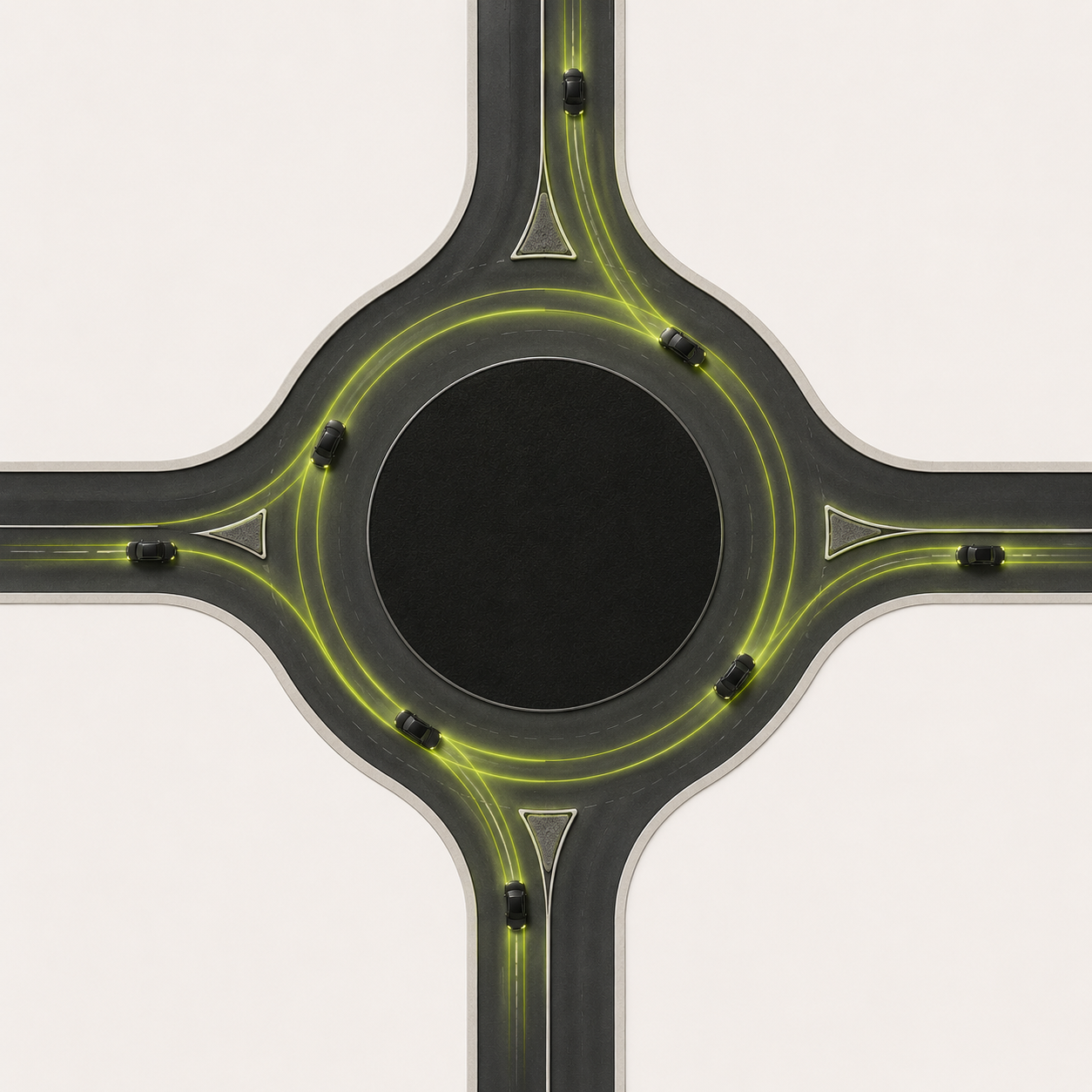
In the Dutch town of Drachten there is a busy junction called the Laweiplein. Some years ago a traffic engineer named Hans Monderman stripped out everything that was meant to control it. The traffic lights went, along with the signs, the road markings and the kerbs. In their place he put an open square with a raised ring of grass and a couple of fountains, and left the drivers, cyclists and pedestrians to sort the crossing out between themselves. Everyone predicted chaos. A year later, accidents at the junction had roughly halved, traffic moved through it more smoothly than before, and it was carrying about a third more cars. Monderman's explanation was blunt: "I don't want traffic behaviour, I want social behaviour." The lights had trained people to watch the signal. Take the signal away and they went back to watching each other, which is what had been keeping them safe all along.
Every company has the same two systems, and companies usually call them the same thing: the org chart. The first chart is the one you can draw, with its boxes, titles and reporting lines, the version that goes in the induction pack. The second one actually runs the place. It records who really holds power, whose sign-off is required no matter what the diagram says, which loyalties predate the current structure, and which conversations happen before the meeting and settle what the meeting will only rubber-stamp.
A small company runs almost entirely on the second chart, and it works beautifully. Trust is high, everyone sits within earshot, and the informal network is the operating system. People know who to ask because they know everyone. The founder can feel the whole company in one look across the room.
Then the company grows and the informal system turns from an asset into a liability. New joiners cannot see it. They read the official chart, act on what it tells them, and keep walking into invisible rules no one thought to explain. Old loyalties harden into territory. The founder's original allies hold informal authority that no longer matches their formal role, and resentment builds on both sides of that mismatch. Decisions drift back into the old private channels, and the capable people hired to make those decisions learn they were never really trusted with them.
This is systemic ground in the proper sense. A company behaves like a living system with its own field: allegiances, unspoken pecking orders, unfinished business, a lingering sense of who was here first and what that entitles them to. None of it appears in a reorganisation deck. All of it will absorb or defeat any reorganisation you attempt if you refuse to name it.
Monderman's junction worked because he made the real system visible and let people act on it, instead of hiding it behind signals that only pretended to be in charge. The same move works in a company, and it is the opposite of what most founders do when scaling gets messy. The instinct is to draw the official chart more forcefully, add another layer of process, insist that people follow the lines on the diagram. That is putting more traffic lights on the junction. The people carry on negotiating through the back channels underneath, only now they are doing it in the dark.
The scaling work is not to redraw the visible chart harder. It is to surface the hidden one, so the invisible allegiances and the unspoken order can be named, renegotiated, or gently retired. What stays hidden runs the company regardless. It just does so without your consent.
Sources: Hans Monderman's redesign of the Laweiplein in Drachten is documented in Tom Vanderbilt, Traffic (2008), and "The Traffic Guru," Wilson Quarterly (Summer 2008). Figures are the reported one-year outcomes for the junction