
What Is Human Behaviour and How Does It Form?
Ask a leader to describe their behaviour and they will describe their intentions. "I'm collaborative. I value openness. I want people to challenge me."
Then watch them in a meeting under pressure.
The gap between those two things — what we say we do and what we actually do — is where the whole story of human behaviour lives. Chris Argyris spent a career on it and gave the gap a name: espoused theory versus theory-in-use. We all carry both. Almost none of us can see the second one.
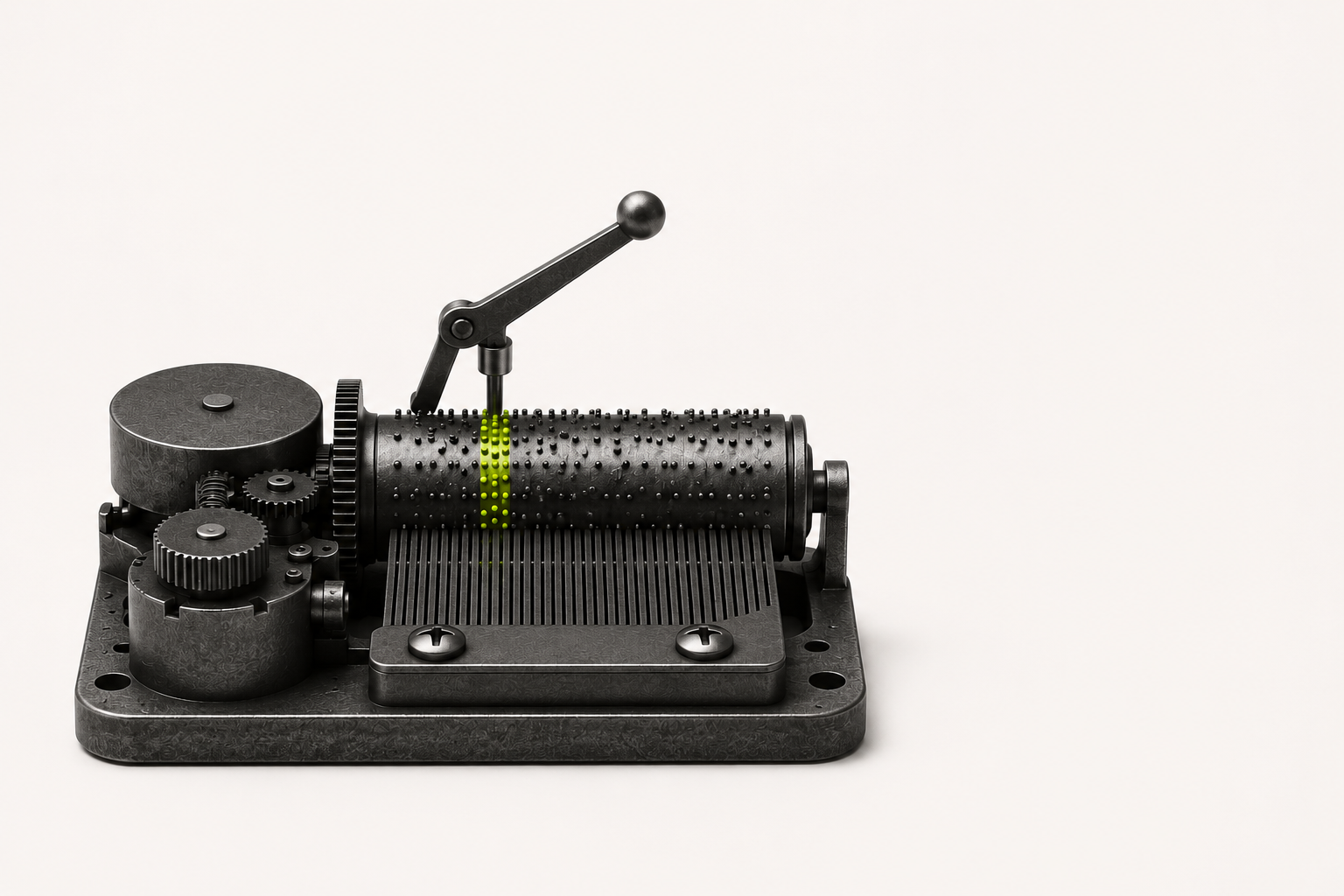
BEHAVIOUR IS NOT CHARACTER. IT'S CODE
Strip away the moral language and behaviour is simply this: the observable output of a prediction system.
Your brain is not primarily a thinking machine; it is a forecasting machine. It runs on roughly twenty watts — less than a light bulb — and its core survival strategy is efficiency. Anything you do repeatedly gets compressed into automatic routine, so that expensive conscious attention can be saved for the genuinely new. Wendy Wood's research found that around 40% of what we do on a given day isn't a fresh decision at all — it's habit: the same action, in the same context, on repeat. You don't decide how to respond to criticism each time. You retrieve the response that's already installed.
Which raises the interesting question: who installed it?
HOW THE CODE GETS WRITTEN
First, environment writes the early patterns. A child's nervous system is a scientist running one experiment on repeat: what works here? In a home where conflict was dangerous, appeasing worked. In a home where only achievement earned attention, performing worked. The child doesn't choose these strategies any more than they choose their accent. Both are absorbed from the room.
Second, repetition hardwires them. Every time a behaviour delivers safety, connection or reward, the neural pathway carrying it gets faster — what fires together wires together. By adulthood, these pathways are motorways. The alternatives are overgrown footpaths.
Third, emotion decides which memories matter. The brain tags high-emotion moments as important and builds predictions around them. One public humiliation at fourteen can quietly shape thirty years of meeting behaviour. The event is forgotten; the rule it wrote — never be caught unprepared — runs daily.
Fourth, context pulls the trigger. Behaviour is not a fixed trait you carry everywhere; it's a response the situation summons. The same executive is generous at home, withering in a steering committee, and charming with clients. Nothing about their character changed between rooms. The cues did. This is why so much behavioural change fails: we try to change the person while leaving the triggers fully loaded.
Fifth, systems reinforce everything. Organisations are behaviour-shaping machines. What gets rewarded, repeated. What gets punished, hidden. Argyris showed that most organisations unintentionally reward defensive routines — saving face, bypassing embarrassment, keeping the undiscussable undiscussed — and then wonder why candour is scarce.
WHY THIS MATTERS FOR ANYONE LEADING ANYTHING.
If behaviour were character, change would require becoming a different person — which is why so many development programmes quietly fail. But behaviour is code: written by a specific environment, for a specific purpose, at a specific time.
Code can be read. And here is the strange, hopeful mechanism at the heart of it: behaviour that is seen clearly begins to loosen on its own. The pattern's power depends on running invisibly, beneath the story we tell about ourselves. The moment a leader can say "Ah — that's what I do, and that's what it was built for," the motorway acquires an exit ramp.
You are not your behaviour. You are the one who can finally read it.